Boosting HIIT Performance: MitoQ as a Training Amplifier
Written by Georgia Truman (MSc), Molecular and Cellular Biology. Reviewed by Dr. Siobhan Mitchell (PhD), Neuroscience.
Antioxidant supplementation during exercise has long presented a paradox: while oxidative damage can impair performance and recovery, reactive oxygen species (ROS) are also essential signalling molecules for training adaptation. This trial tested whether mitochondria‑targeted antioxidant therapy could resolve that tension by reducing pathological oxidative stress while preserving — or even enhancing — adaptive signalling.
Research summary
Evidence type: Randomised, double‑blind, placebo‑controlled human training intervention study
Claim strength: Mechanistic and functional evidence supported by controlled human intervention
Population: Healthy adults undertaking a structured high‑intensity interval training (HIIT) programme
Intervention: Chronic mitoquinol (MitoQ) supplementation (20 mg/day) during a 3‑week HIIT training block
Observed outcome: Greater improvements in peak power output, increased exercise‑induced PGC‑1α expression, and increased skeletal muscle VEGF expression compared with placebo
Causality: Supported for enhancement of training‑related molecular and performance adaptations; long‑term performance and clinical outcomes not established
Primary source: Redox Biology (2022)
What you’ll learn
Why ROS are both necessary for exercise adaptation and damaging at excess levels
How mitochondria‑targeted antioxidants differ from conventional antioxidant supplementation
The effects of MitoQ on PGC‑1α expression, peak power output, and vascular signalling during HIIT
What these findings imply for training adaptation in untrained and ageing populations
Why does antioxidant supplementation during exercise require careful consideration?
During exercise, transient increases in ROS act as signalling molecules that activate key adaptive pathways, including PGC‑1α‑mediated mitochondrial biogenesis and Nrf2‑regulated antioxidant responses. These brief oxidative bursts are a necessary stimulus for improvements in mitochondrial content, endurance capacity, and metabolic efficiency.
Difficulties arise when antioxidants suppress this signal indiscriminately. Broad‑spectrum antioxidants such as vitamins C and E neutralise ROS throughout the cell, and multiple trials have shown that this blunts mitochondrial biogenesis, endothelial adaptation, and gains in performance. The central challenge has therefore been distinguishing pathological oxidative damage from the physiological redox signalling that underpins training benefit.
Does MitoQ interfere with or enhance training adaptations?
This study addressed that question by focusing on mitochondrial specificity. Because MitoQ accumulates within mitochondria, it selectively reduces excess superoxide production at the source, without suppressing cytosolic or nuclear redox signalling critical for adaptation.
To test whether this distinction mattered in practice, participants undertook a 3‑week double‑blind HIIT programme while receiving either MitoQ (20 mg/day) or placebo. Despite identical training loads, those receiving MitoQ exhibited significantly greater improvements in peak power output. Rather than merely avoiding interference, mitochondrial redox optimisation appeared to enhance functional adaptation to training.
What was the effect of MitoQ on PGC‑1α expression?
To determine whether performance gains reflected enhanced cellular adaptation, investigators examined exercise‑induced changes in PGC‑1α — the master transcriptional regulator of mitochondrial biogenesis and endurance adaptation.
Following HIIT, increases in PGC‑1α mRNA were significantly greater in the MitoQ group than in placebo. This suggests that reducing mitochondrial oxidative disruption preserves the energetic and redox environment required for robust transcriptional activation, allowing a stronger adaptive response to the same exercise stimulus.
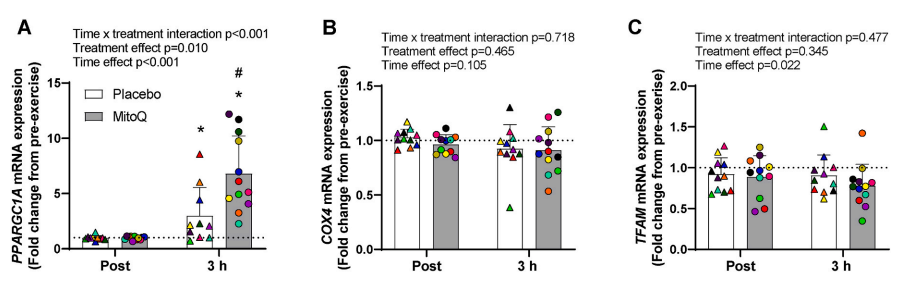
Image taken from Broom et al., 2022
What was the impact on muscle blood flow markers?
The study also evaluated vascular signals that support long‑term performance improvement. MitoQ supplementation increased skeletal muscle expression of vascular endothelial growth factor (VEGF), a key regulator of capillary growth and microvascular remodelling.
Enhanced capillarisation improves oxygen delivery, metabolite clearance, and recovery between intervals. By augmenting both mitochondrial and vascular plasticity, Mitoquinol appears to influence complementary components of aerobic performance rather than acting on a single adaptation pathway.
What are the takeaways for high‑performance practitioners?
Taken together, these findings position MitoQ as mechanistically distinct from conventional antioxidants. Rather than suppressing redox signalling, it reduces exercise‑induced oxidative damage while amplifying — rather than attenuating — downstream adaptive responses.
Notably, these effects emerged within a single 3‑week training block, aligning with practical programming cycles. For practitioners working with untrained, older, or metabolically constrained individuals, the results suggest that mitochondrial redox balance may represent a limiting factor in adaptation — and a modifiable one.
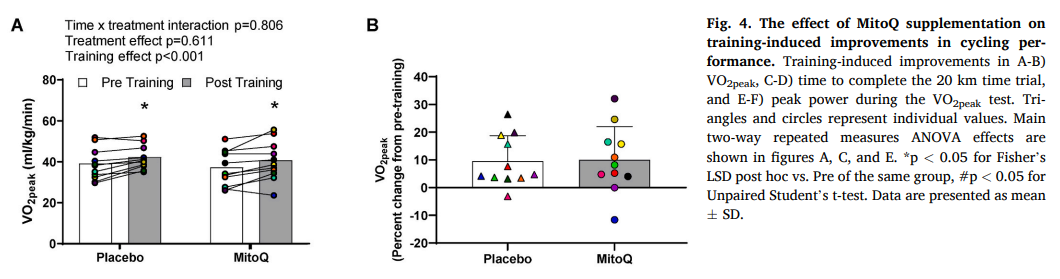
Image taken from Broom et al., 2022
Read the full article: MitoQ supplementation augments acute exercise-induced increases in muscle PGC1α mRNA and improves training-induced increases in peak power independent of mitochondrial content and function in untrained middle-aged men
DOI: 10.1016/j.redox.2022.102341