MitoQ vs CoQ10: What does the clinical evidence tell us?
Written by Tyla Cornish (BNatMed), Naturopath. Reviewed by Dr. Siobhan Mitchell (PhD), Neuroscience.
Coenzyme Q10 (CoQ10) is one of the most widely used nutritional supplements worldwide, recognised for its role in cellular energy production and antioxidant defence. MitoQ was developed from the same ubiquinone backbone but engineered to selectively accumulate within mitochondria, the primary site of cellular energy generation and a major source of reactive oxygen species (ROS).
Although both compounds share a similar antioxidant mechanism, their biological behaviour differs considerably. This raises an important clinical question: does specifically targeting mitochondria produce different outcomes compared with conventional CoQ10 supplementation?
Several human clinical trials have now investigated MitoQ across ageing, cardiovascular health, exercise physiology, mitochondrial redox biology, and chronic disease. Among these studies, a randomised crossover trial directly comparing MitoQ and CoQ10 in healthy middle-aged men provides the clearest evidence for understanding how these molecules differ in practice.
What you'll learn
How MitoQ differs structurally and functionally from conventional CoQ10
Why mitochondrial targeting may influence antioxidant efficacy
What human clinical trials reveal about MitoQ versus CoQ10
When reductions in oxidative stress do and do not translate into clinical benefits
Why context appears to be one of the most important determinants of response
What is the difference between MitoQ and CoQ10?
Both molecules contain a ubiquinone component that participates in redox reactions and antioxidant defence. CoQ10 is naturally present throughout the body and plays an essential role in mitochondrial electron transport and ATP production.
MitoQ was developed by attaching the ubiquinone molecule to a lipophilic triphenylphosphonium (TPP⁺) cation. This positively charged component enables MitoQ to accumulate within mitochondria in response to the mitochondrial membrane potential, allowing concentrations substantially higher than those achieved by conventional CoQ10.
As a result, while both compounds can act as antioxidants, MitoQ is designed to exert its effects directly at the site where mitochondrial ROS are generated.
What does the head-to-head clinical trial show?
The most direct comparison comes from a randomised double-blind crossover study involving 20 healthy middle-aged men who received either MitoQ (20 mg daily) or CoQ10 (200 mg daily) for six weeks, separated by a washout period. Researchers measured skeletal muscle mitochondrial ROS production, mitochondrial function, oxidative stress biomarkers, and antioxidant enzyme expression.
Both supplements reduced mitochondrial hydrogen peroxide production during leak respiration states, indicating that both compounds were capable of reducing mitochondrial oxidative stress. However, the effects of MitoQ extended across more respiratory conditions than CoQ10, suggesting a broader influence on mitochondrial redox balance.
One of the most notable findings was that MitoQ increased expression of catalase, an endogenous antioxidant enzyme responsible for converting hydrogen peroxide into water. CoQ10 did not produce this response. Researchers also observed increased expression of TXN1 following MitoQ supplementation, providing further evidence of an adaptive antioxidant response.
Importantly, these effects occurred despite MitoQ being administered at one tenth of the dose used for CoQ10 (20 mg versus 200 mg daily).
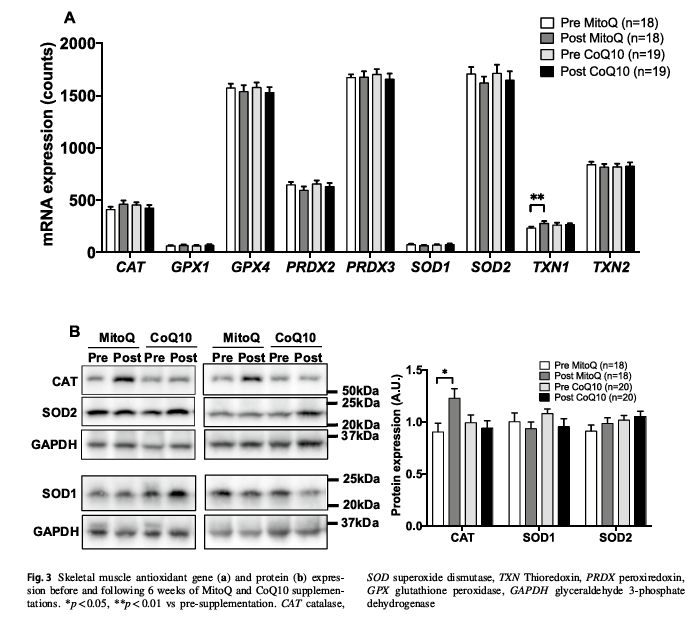
Figure taken from Pham et al. 2020.
Did either supplement improve mitochondrial function?
Despite reducing mitochondrial ROS production, neither MitoQ nor CoQ10 improved mitochondrial respiration, oxidative phosphorylation capacity, citrate synthase activity, mitochondrial DNA content, markers of mitochondrial biogenesis, insulin sensitivity, blood lipids or systemic oxidative stress biomarkers in these healthy middle-aged participants.
This finding is important because it highlights a recurring theme across the MitoQ literature: reducing oxidative stress alone does not automatically improve physiological function.
What do broader clinical trials tell us?
The placebo-controlled mechanistic findings from Pham et al. align closely with observations across other human studies. Studies in healthy young adults often find little or no functional benefit from MitoQ supplementation. For example, acute supplementation did not alter vascular function, blood pressure, arterial stiffness, or oxidative stress markers in healthy young individuals. Similarly, MitoQ did not enhance endurance training adaptations or increase aerobic capacity in healthy populations.
However, different results emerge when mitochondrial oxidative stress is elevated. In healthy older adults, six weeks of MitoQ supplementation improved endothelial function and reduced arterial stiffness. In another study, MitoQ increased leg-extension power by approximately 11% without affecting strength or aerobic capacity. In patients with peripheral artery disease, a single dose improved endothelial function and walking performance. In type 2 diabetes, MitoQ improved myocardial energetics and diastolic function without affecting glycaemic control.
Across these studies a consistent pattern emerges: MitoQ appears most effective in populations where mitochondrial dysfunction or oxidative stress is already contributing to physiological impairment.
Why might MitoQ perform differently from CoQ10?
The human evidence suggests three key distinctions:
MitoQ reaches mitochondria more efficiently: The TPP⁺ moiety enables selective accumulation within mitochondria, resulting in substantially higher local concentrations than conventional CoQ10.
MitoQ appears to influence endogenous antioxidant responses: The increase in catalase and TXN1 expression observed in the Pham trial suggests that it may not simply act as a passive antioxidant but may also activate adaptive redox defence pathways.
MitoQ has demonstrated clinical efficacy across multiple disease-related and ageing-associated outcomes, including vascular function, skeletal muscle power, peripheral artery disease, and myocardial energetics: While CoQ10 also possesses well-established cardiovascular and antioxidant properties, comparable head-to-head clinical outcome studies are limited. As a result, direct conclusions regarding superiority for disease outcomes cannot currently be drawn.
What are the clinical implications?
Current evidence suggests that MitoQ and CoQ10 should not be viewed as interchangeable molecules.
Both compounds can reduce mitochondrial oxidative stress, but MitoQ appears to exert stronger effects within mitochondria and may stimulate endogenous antioxidant defences more effectively. The Pham trial showed that these effects can be achieved at substantially lower doses than traditional CoQ10 supplementation.
At the same time, neither compound appears to improve mitochondrial function in healthy individuals with relatively preserved metabolic health. This reinforces the idea that antioxidant interventions are most likely to show benefit when oxidative stress is elevated and function is already compromised.
Taken together, the clinical literature suggests that MitoQ's primary advantage is not simply that it is an antioxidant, but that it is a mitochondria-targeted antioxidant. The available evidence indicates that this distinction becomes increasingly relevant in ageing, vascular dysfunction, and chronic disease states, where mitochondria may play a more direct role in driving physiological decline.
Primary source: MitoQ and CoQ10 supplementation mildly suppresses skeletal muscle mitochondrial hydrogen peroxide levels without impacting mitochondrial function in middle-aged men (DOI: 10.1007/s00421-020-04396-4).