

What is Mitoquinol?
A Mitochondria-targeted Form of CoQ10
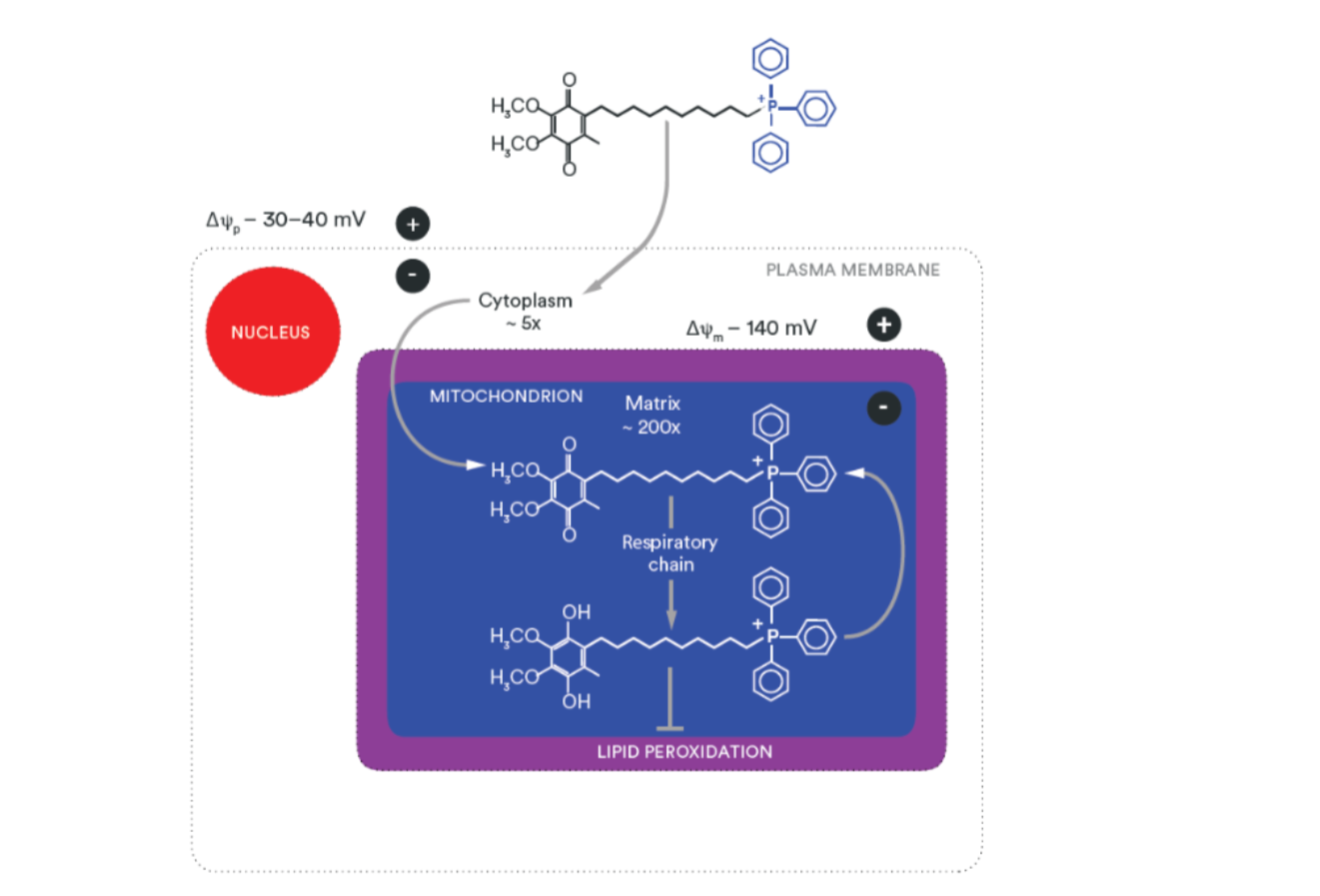
Mitoquinol mesylate (MitoQ®) is a mitochondria-targeted antioxidant built from the ubiquinol head group of coenzyme Q10 (CoQ10), joined by a ten-carbon chain to a lipophilic triphenylphosphonium (TPP⁺) cation. The cation uses the negative membrane potential across the plasma and inner mitochondrial membranes to concentrate the compound several hundred-fold inside mitochondria, where it sits in the inner membrane close to the main sites of superoxide production¹⁻³. There it limits lipid peroxidation and is recycled back to its active ubiquinol form by complex II, allowing low milligram doses to act repeatedly²,⁴. Mitoquinol was designed by Professor Mike Murphy and Dr Robin Smith as a research tool to test whether mitochondrial oxidative stress drives disease, and it has since been studied in more than 30 human trials, most at 10–20 mg/day. Human data show consistent changes in oxidative stress biomarkers and vascular function; evidence for long-term clinical outcomes remains limited, and one large trial in Parkinson’s disease was null⁵.
The Need for Mitochondria-Targeted Antioxidants
For several decades, oxidative stress has been one of the most widely proposed explanations for ageing and chronic disease. Yet the large antioxidant trials of the 1990s and 2000s, which tested vitamins E, C and beta-carotene, largely failed to show clinical benefit. One explanation for this gap is location. Most cellular superoxide is generated inside mitochondria, at complexes I and III of the electron transport chain, and much of the resulting damage falls on mitochondrial membranes, proteins and DNA³. An antioxidant that circulates in plasma or distributes through the cytosol may simply never reach that compartment in useful amounts.
CoQ10 illustrates the problem well. It is an essential electron carrier and the main lipid-soluble antioxidant of the inner mitochondrial membrane, and tissue levels fall with age and with statin use. Oral CoQ10, however, is one of the most hydrophobic molecules in the diet: absorption is slow and incomplete, and very little of an oral dose reaches mitochondria in tissues that already make their own⁶. Raising the dose does not solve this, because uptake saturates.
Mitoquinol was developed to address this delivery problem directly. Rather than adding more antioxidant to the body, it places a small amount where mitochondrial reactive oxygen species (mtROS) are made. That design also makes it a useful experimental tool: if a phenotype improves when mtROS are selectively reduced, mitochondrial oxidative stress is likely part of its cause⁷.
The challenge: getting an antioxidant into the inner membrane
The inner mitochondrial membrane is where oxygen is reduced, where electrons occasionally leak to form superoxide, and where polyunsaturated lipids such as cardiolipin are most exposed to peroxidation. An effective mitochondrial antioxidant therefore has to cross the gut wall, the plasma membrane and both mitochondrial membranes, then stay in the inner membrane long enough to act. Few conventional antioxidants manage all four steps, and those that do, including CoQ10, reach mitochondria only in small amounts⁶.
The solution: using the membrane potential as a delivery system
In the late 1990s, Murphy and Smith, then at the University of Otago, combined two ideas. Mitochondria maintain a large negative charge across their inner membrane, typically around −150 to −180 mV, and lipophilic cations move down that gradient in a predictable way¹. By attaching an antioxidant to a cation that can pass through lipid bilayers, the membrane potential itself could do the work of targeting.
The result was mitoquinol: the ubiquinol head of CoQ10 linked through a ten-carbon (decyl) chain to triphenylphosphonium². The TPP⁺ group carries a positive charge spread over three phenyl rings, which lets it pass through membranes without a transporter. The decyl linker was chosen to balance two needs: enough lipophilicity to cross membranes quickly, and enough water solubility to be absorbed orally and distributed in blood⁸.
Successful design: concentration where it counts
Uptake follows the Nernst equation, which predicts roughly a tenfold accumulation for every 60 mV of membrane potential. The plasma membrane potential concentrates mitoquinol about five- to tenfold in the cytosol; the mitochondrial membrane potential concentrates it a further 100- to 500-fold in the matrix¹. Tissues with many active mitochondria and high potentials, such as heart, skeletal muscle, liver, kidney and brain, take up the most¹⁰.
Once inside, mitoquinol does not float freely in the matrix. Its TPP⁺ group sits at the matrix face of the inner membrane while the ubiquinol head reaches into the lipid core, close to where lipid peroxidation chain reactions start⁹. This is the same region CoQ10 occupies, but at a much higher local concentration than an oral CoQ10 dose could provide.
One point of terminology is worth clarifying. Mitoquinone is the oxidised form and mitoquinol the reduced, antioxidant form; the two interconvert inside mitochondria. Early trials and much of the preclinical literature describe the compound as mitoquinone mesylate, while the stabilised supplement is described as mitoquinol mesylate¹¹.
How Mitoquinol Works
Absorption and distribution: from gut to inner membrane
After an oral dose, mitoquinol is absorbed from the gastrointestinal tract and reaches peak plasma concentrations within about an hour in humans¹⁰. Because the TPP⁺ cation crosses lipid bilayers directly, the compound moves into cells and mitochondria within minutes of reaching them in cell studies², and it crosses the blood–brain barrier. In mice, conference data from Woodhead and Jaiswal suggest substantially greater mitochondrial bioavailability than CoQ10 at a fraction of the dose; this finding has so far been reported only as an abstract¹².
Antioxidant action: interrupting lipid peroxidation at its source
Within the inner membrane, the ubiquinol head donates a hydrogen atom to lipid peroxyl radicals, breaking the chain reaction that would otherwise spread through membrane phospholipids. In isolated mitochondria and cells, this protects against lipid peroxidation, reduces damage from superoxide and peroxynitrite, and prevents oxidant-induced apoptosis². Human studies add a second, indirect effect: mitoquinol supplementation has been associated with increased activity or expression of endogenous antioxidant enzymes such as catalase and glutathione peroxidase¹³,¹⁴. Whether this reflects direct signalling or an adaptive response to altered redox tone is not yet established.
Redox recycling: why small doses work
After neutralising a radical, mitoquinol is oxidised to mitoquinone. Complex II (succinate dehydrogenase) then reduces it back to the active ubiquinol form, using electrons from the citric acid cycle⁴,⁹. Each molecule can therefore act many times, which is the main reason doses of 10–20 mg are used rather than the 100–300 mg typical of CoQ10.
This recycling has an important limit. Mitoquinol is a poor substrate for complexes I and III, so it does not carry electrons through the respiratory chain and cannot restore respiration in CoQ10-deficient mitochondria⁴,⁹. It should be understood as a targeted antioxidant, not as a substitute for CoQ10’s role in ATP production.
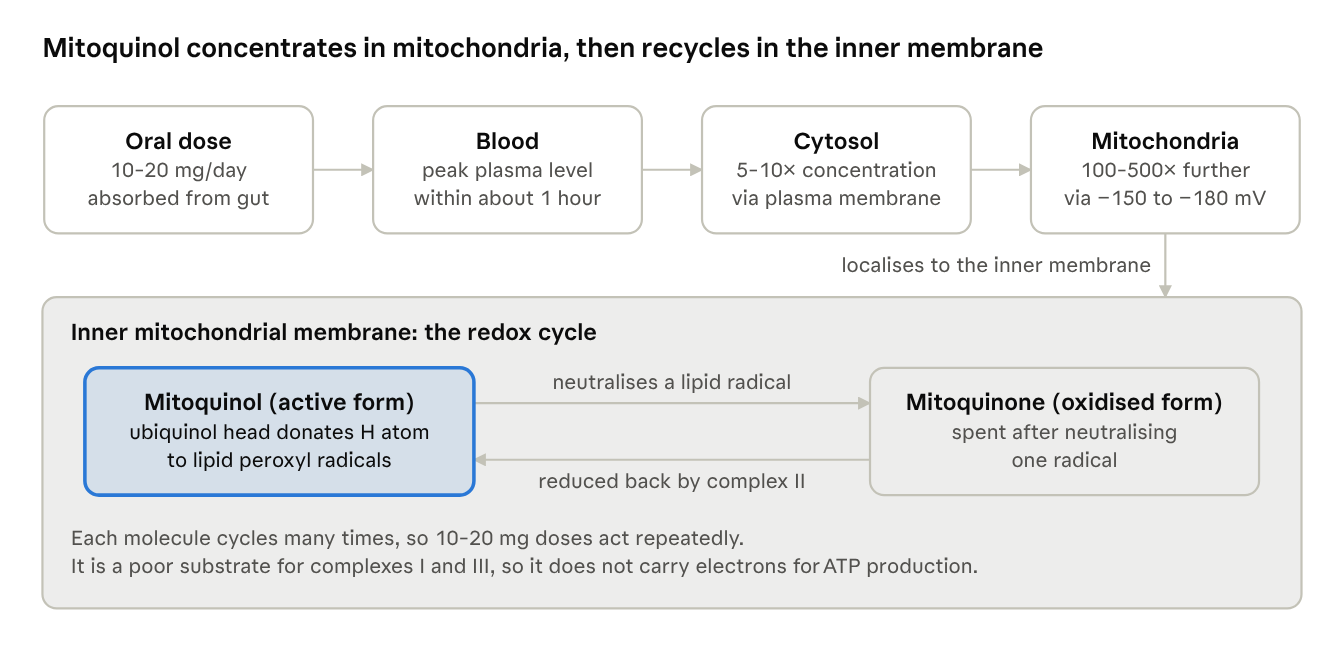
Figure 1. Mitoquinol uptake and redox recycling. The membrane potential concentrates mitoquinol in two steps, first in the cytosol and then in the mitochondrial matrix. In the inner membrane, complex II returns it to its active form after each antioxidant event.
Selectivity and safety: a low pro-oxidant risk
Quinones can act as pro-oxidants under some conditions, so this was tested early. In wild-type mice given high oral doses for up to 28 weeks, mitoquinol caused no increase in oxidative damage to mitochondrial protein, DNA or cardiolipin and no change in mitochondrial gene expression or enzyme activity¹⁵. A subchronic oral toxicity study with genotoxicity testing supported its use as a food ingredient¹¹. Equally, its effects depend on the presence of oxidative stress: in healthy tissue with low mtROS, little measurable change should be expected.
Real-World Example: Exercise
Exercise shows why a targeted antioxidant behaves differently from a general one. A hard training session raises mtROS in working muscle. Some of this is damaging, oxidising membranes and mitochondrial DNA, but some is a signal: transient ROS help activate PGC-1α and the programmes that build new mitochondria and antioxidant defences. High-dose vitamins C and E, taken during endurance training, have been shown to blunt markers of these adaptations¹⁶.
Mitoquinol has been tested in this setting several times. In healthy men, 20 mg/day for three weeks attenuated the rise in mitochondrial and nuclear DNA damage after high-intensity exercise¹⁷. In young men completing three weeks of endurance training, it neither enhanced nor reduced the training-induced gains in muscle oxidative capacity and VO₂max¹⁸. In untrained middle-aged men, supplementation during interval training augmented exercise-induced PGC-1α mRNA and produced larger gains in peak power, without changing mitochondrial content¹⁹. In trained middle-aged cyclists, four weeks of 20 mg/day improved 8 km time-trial performance²⁰.
Taken together, these trials suggest that reducing oxidative damage at its mitochondrial source does not remove the redox signal needed for adaptation, in contrast to broad-spectrum antioxidants. The performance findings are modest and come from small samples of men, so they should be read as promising rather than settled.
Mitoquinol and CoQ10: How They Differ
Mitoquinol and CoQ10 share an antioxidant head group but serve different purposes. CoQ10 is a bioenergetic cofactor and general lipid antioxidant; mitoquinol is a targeted antioxidant that does not take part in electron transport. The only head-to-head human trial compared 20 mg/day mitoquinol with 200 mg/day CoQ10 for six weeks in middle-aged men. Both mildly lowered mitochondrial hydrogen peroxide in skeletal muscle without changing mitochondrial respiration, and only mitoquinol increased catalase expression¹³. For practitioners, the two are complementary rather than interchangeable. A patient with documented CoQ10 deficiency needs CoQ10; a patient in whom mitochondrial oxidative stress is the more plausible problem may be better served by a targeted compound.
| Feature | CoQ10 (ubiquinone or ubiquinol) | Mitoquinol mesylate |
|---|---|---|
| Primary role | Electron carrier in the respiratory chain; general lipid-soluble antioxidant | Targeted antioxidant in the inner mitochondrial membrane |
| Typical oral dose | 100–300 mg/day, taken with fat | 10–20 mg/day |
| Oral absorption | Low and variable; uptake saturates at higher doses6 | Absorbed rapidly; peak plasma levels within about an hour10 |
| Mitochondrial uptake | Limited; no specific transporter6 | Driven by membrane potential; 100- to 500-fold accumulation in the matrix1 |
| Recycling | Reduced by the respiratory chain as part of normal electron flow | Reduced by complex II after each antioxidant event4 |
| Supports ATP production | Yes, where CoQ10 is deficient | No; poor substrate for complexes I and III4 |
| Head-to-head human data | Mild reduction in muscle mitochondrial H2O213 | Mild reduction in muscle mitochondrial H2O2 plus increased catalase13 |
| Best-suited uses | CoQ10 deficiency, statin-associated depletion, primary CoQ10 disorders | Conditions or research questions centred on mitochondrial oxidative stress |
For practitioners, the two are complementary rather than interchangeable. A patient with documented CoQ10 deficiency needs CoQ10; a patient in whom mitochondrial oxidative stress is the more plausible problem may be better served by a targeted compound.
Practitioner Lens
Where the human evidence sits
The strongest and most consistent human findings are vascular. Endothelial cells depend heavily on mitochondrial redox balance, and excess mtROS reduce nitric oxide availability; this provides a clear mechanistic rationale for the results below. Selected trials are summarised by population, dose and outcome, including null findings.
| Population | Dose and duration | Main finding | Design notes |
|---|---|---|---|
| Healthy adults aged 60–7921 | 20 mg/day, 6 weeks | Flow-mediated dilation improved by about 42%; lower oxidised LDL; reduced aortic stiffness in those with high baseline values | Randomised, placebo-controlled crossover; n = 20 |
| Hypertension, with endurance training22 | 20 mg/day, 6 weeks | Lower systolic blood pressure; reduced MDA and IL-6 | Randomised, double-blind; combined with exercise |
| Peripheral artery disease23 | 80 mg, single dose | Improved endothelial function, antioxidant enzyme activity and walking tolerance | Acute study; long-term effects unknown |
| Chronic kidney disease24 | 20 mg/day, 4 weeks | Improved flow-mediated dilation; microvascular improvement of borderline significance; no change in exercise capacity | Randomised pilot; n = 18 |
| Chronic hepatitis C25 | 40 or 80 mg/day, 28 days | Reduced serum ALT | Phase II, randomised; no change in viral load |
| Early, untreated Parkinson’s disease5 | 40 or 80 mg/day, 12 months | No difference from placebo on any measure of progression | Randomised, double-blind; n = 128 |
| Fibromyalgia and ME/CFS26 | 20 mg/day, 12 weeks | Reported improvements in pain, energy, sleep and cognition | Open-label and not peer reviewed; hypothesis-generating only |
The Parkinson’s result is worth discussing with patients and colleagues rather than leaving out. It suggests that by the time neurodegeneration is clinically apparent, reducing mitochondrial oxidative stress alone may not alter its course, or that the trial measures were not sensitive to the effect. It does not show that mitoquinol is ineffective in other settings.
Biomarkers and functional readouts
| Measure | What it may indicate | Key limitation |
|---|---|---|
| Flow-mediated dilation | Endothelial nitric oxide bioavailability | Operator-dependent; requires standardised conditions |
| Carotid–femoral pulse wave velocity | Large-artery stiffness | Changes slowly; small trials may miss effects |
| F2-isoprostanes, MDA | Systemic lipid peroxidation | Not specific to mitochondria; MDA assays vary in quality |
| Oxidised LDL | Oxidative modification of lipoproteins | Reflects systemic rather than mitochondrial oxidative stress |
| mtDNA damage in blood cells | Mitochondrial oxidative damage | Research assay; not available in routine practice |
| Catalase, glutathione peroxidase activity | Endogenous antioxidant capacity | Tissue and timing dependent |
In routine practice, most of these are research tools. Functional outcomes, such as blood pressure, exercise tolerance and validated fatigue scales, are usually more practical ways to monitor response.
Dosing in practice
Most human trials use 20 mg/day, which is the best-supported dose for cardiovascular and exercise outcomes. For general use in healthy adults, a starting dose of 10 mg/day is commonly suggested, increasing to 20 mg if needed. Higher doses (40–80 mg) have been used in disease trials for up to 12 months. Clinical experience suggests that some people with chronic fatigue or primary mitochondrial disease prefer 5–10 mg, describing higher doses as stimulating; this is anecdotal and has not been formally tested. Most trials ran for four weeks to three months, so a trial of at least two to three months is reasonable before judging response.
Safety and tolerability
Mitoquinol has been well tolerated at 10–20 mg/day in published trials. The most frequent adverse effects are gastrointestinal, mainly nausea, and these were more common at 80 mg/day⁵. Safety in pregnancy, breastfeeding and children has not been established. Interactions with medicines that alter mitochondrial membrane potential or redox state have not been studied systematically, so clinical judgement and monitoring are appropriate in complex polypharmacy.
Practitioner interpretation
Mitoquinol is best positioned as a targeted tool for situations where mitochondrial oxidative stress is a plausible contributor: vascular ageing, endothelial dysfunction, high training loads, and conditions with documented oxidative burden. It does not replace CoQ10 where CoQ10 is deficient, and it does not replace the lifestyle measures, particularly regular exercise, that have the strongest evidence for mitochondrial health. Improvements in biomarkers should not be assumed to translate into reduced disease risk until longer outcome trials are available.
Current Evidence
The mechanism is well characterised. Mitoquinol accumulates in mitochondria in proportion to membrane potential, localises to the inner membrane, protects against lipid peroxidation and is recycled by complex II¹,²,⁴,⁹. In humans, it is well tolerated at 10–20 mg/day, and randomised trials consistently show improvements in endothelial function and reductions in oxidative stress markers²¹,²⁴. It does not appear to blunt exercise adaptations¹⁸.
Preclinical work has linked mitoquinol to mitochondrial quality control, including mitophagy and signalling through AMPK, sirtuins and PGC-1α, and to protection in models of cardiac ischaemia–reperfusion injury and age-related endothelial dysfunction⁷,²⁷,²⁸. Translating these findings into human outcomes is an active area. Research is also examining fertility, where oocytes and sperm are highly sensitive to oxidative damage, and post-viral fatigue.
Most human trials are small, short and conducted in men or healthy older adults. No trial has yet shown an effect on hard clinical endpoints such as cardiovascular events. Not every model responds: in aged mice, 15 weeks of mitoquinol did not reduce muscle oxidative damage or prevent age-related loss of muscle mass and function²⁹, and the Parkinson’s trial was null⁵. Optimal dosing, timing and duration for most conditions have not been defined, and it remains unclear which patients are most likely to respond.
| Evidence type | What it can establish | What it cannot establish alone |
|---|---|---|
| Mechanistic and cell studies | How mitoquinol is taken up, where it acts and how it is recycled | Human benefit or safety |
| Animal studies | Whether mitochondrial oxidative stress causes a phenotype in a model | Equivalent effects in humans |
| Human biomarker trials | Target engagement: reduced oxidative damage, improved vascular function | Clinical benefit or longer life |
| Human clinical trials | Relevance in the studied population and dose | Generalisability to other conditions or long-term use |
Mitoquinol as a Research Tool
Mitoquinol was designed to answer a causal question: does oxidative stress arising inside mitochondria drive a given outcome? Because it acts selectively in that compartment and at low doses, a positive result supports a mitochondrial mechanism in a way that a general antioxidant cannot⁷.
Three findings illustrate this value. In older adults, improvements in flow-mediated dilation with mitoquinol indicate that mtROS contribute to age-related endothelial dysfunction in humans, not only in animal models²¹,²⁸. In exercise studies, reduced mtDNA damage without blunted adaptation suggests that damaging and signalling ROS can be partly separated¹⁷,¹⁸. The null Parkinson’s trial, in turn, argues against mitochondrial oxidative stress as a sole driver of disease progression once symptoms are established⁵.
Research opportunities and gaps
The clearest gaps are longer trials with clinical endpoints, studies in women and in more diverse populations, and dose–response work. Biomarker-guided designs, which select participants with evidence of elevated oxidative stress, may also help identify who benefits. MCRP supports this work through collaborative research with investigators studying mitochondrial health and disease.
Key Takeaways
Mitoquinol joins the ubiquinol head of CoQ10 to a TPP⁺ cation, using the mitochondrial membrane potential to accumulate 100- to 500-fold in the mitochondrial matrix.
It acts in the inner membrane as a chain-breaking antioxidant and is recycled by complex II, which explains why 10–20 mg doses are effective.
It does not carry electrons for ATP production, so it complements CoQ10 rather than replacing it.
Human trials most consistently show improved endothelial function and lower oxidative stress markers, without blunting exercise adaptation.
Evidence for long-term clinical outcomes is limited; trials are small and short, and a 12-month Parkinson’s trial was null.
References
Murphy MP. Targeting lipophilic cations to mitochondria. Biochim Biophys Acta. 2008;1777(7–8):1028–1031. doi:10.1016/j.bbabio.2008.03.029
Kelso GF, Porteous CM, Coulter CV, et al. Selective targeting of a redox-active ubiquinone to mitochondria within cells: antioxidant and antiapoptotic properties. J Biol Chem. 2001;276(7):4588–4596. doi:10.1074/jbc.M009093200
Murphy MP. How mitochondria produce reactive oxygen species. Biochem J. 2009;417(1):1–13. doi:10.1042/BJ20081386
James AM, Cocheme HM, Smith RAJ, Murphy MP. Interactions of mitochondria-targeted and untargeted ubiquinones with the mitochondrial respiratory chain and reactive oxygen species. J Biol Chem. 2005;280(22):21295–21312. doi:10.1074/jbc.M501527200
Snow BJ, Rolfe FL, Lockhart MM, et al. A double-blind, placebo-controlled study to assess the mitochondria-targeted antioxidant MitoQ as a disease-modifying therapy in Parkinson’s disease. Mov Disord. 2010;25(11):1670–1674. doi:10.1002/mds.23148
Bhagavan HN, Chopra RK. Coenzyme Q10: absorption, tissue uptake, metabolism and pharmacokinetics. Free Radic Res. 2006;40(5):445–453. doi:10.1080/10715760600617843
Murphy MP, Hartley RC. Mitochondria as a therapeutic target for common pathologies. Nat Rev Drug Discov. 2018;17(12):865–886. doi:10.1038/nrd.2018.174
Asin-Cayuela J, Manas AR, James AM, Smith RAJ, Murphy MP. Fine-tuning the hydrophobicity of a mitochondria-targeted antioxidant. FEBS Lett. 2004;571(1–3):9–16. doi:10.1016/j.febslet.2004.06.045
James AM, Sharpley MS, Manas AR, et al. Interaction of the mitochondria-targeted antioxidant MitoQ with phospholipid bilayers and ubiquinone oxidoreductases. J Biol Chem. 2007;282(20):14708–14718. doi:10.1074/jbc.M611463200
Smith RAJ, Murphy MP. Animal and human studies with the mitochondria-targeted antioxidant MitoQ. Ann N Y Acad Sci. 2010;1201:96–103. doi.org/10.1111/j.1749-6632.2010.05627.x
Mitchell ES, Lemke S, Woodhead B, Coleman D. Oral subchronic toxicity study and genetic toxicity evaluation of mitoquinone mesylate. J Appl Toxicol. 2024;44(10):1555–1571. doi:10.1002/jat.4654
Woodhead B, Jaiswal J. Mitochondrial bioavailability of mitoquinol mesylate orally administered to mice [conference abstract, EBEC 2024]. Biochim Biophys Acta Bioenerg. 2024;1865(Suppl):149344.
Pham T, MacRae CL, Broome SC, et al. MitoQ and CoQ10 supplementation mildly suppresses skeletal muscle mitochondrial hydrogen peroxide levels without impacting mitochondrial function in middle-aged men. Eur J Appl Physiol. 2020;120(7):1657–1669. doi:10.1007/s00421-020-04396-4
Aminizadeh S, et al. MitoQ supplementation during vigorous training improves reactive oxygen species, glutathione peroxidase, and miRNAs regulating vascular inflammation in cyclists. Braz Arch Biol Technol. 2023;66:e23220914.
Rodriguez-Cuenca S, Cocheme HM, Logan A, et al. Consequences of long-term oral administration of the mitochondria-targeted antioxidant MitoQ to wild-type mice. Free Radic Biol Med. 2010;48(1):161–172. doi.org/10.1016/j.freeradbiomed.2009.10.039
Paulsen G, Cumming KT, Holden G, et al. Vitamin C and E supplementation hampers cellular adaptation to endurance training in humans: a double-blind, randomised, controlled trial. J Physiol. 2014;592(8):1887–1901. doi:10.1113/jphysiol.2013.267419
Williamson J, Hughes CM, Cobley JN, Davison GW. The mitochondria-targeted antioxidant MitoQ attenuates exercise-induced mitochondrial DNA damage. Redox Biol. 2020;36:101673. doi:10.1016/j.redox.2020.101673
Shill DD, Southern WM, Willingham TB, et al. Mitochondria-specific antioxidant supplementation does not influence endurance exercise training-induced adaptations in circulating angiogenic cells, skeletal muscle oxidative capacity or maximal oxygen uptake. J Physiol. 2016;594(23):7005–7014. doi:10.1113/JP272491
Broome SC, Pham T, Braakhuis AJ, et al. MitoQ supplementation augments acute exercise-induced increases in muscle PGC1α mRNA and improves training-induced increases in peak power independent of mitochondrial content and function in untrained middle-aged men. Redox Biol. 2022;53:102341. doi:10.1016/j.redox.2022.102341
Broome SC, Braakhuis AJ, Mitchell CJ, Merry TL. Mitochondria-targeted antioxidant supplementation improves 8 km time trial performance in middle-aged trained male cyclists. J Int Soc Sports Nutr. 2021;18(1):58. doi:10.1186/s12970-021-00454-x
Rossman MJ, Santos-Parker JR, Steward CAC, et al. Chronic supplementation with a mitochondrial antioxidant (MitoQ) improves vascular function in healthy older adults. Hypertension. 2018;71(6):1056–1063. doi:10.1161/HYPERTENSIONAHA.117.10787
Masoumi-Ardakani Y, et al. Moderate endurance training and MitoQ improve cardiovascular function, oxidative stress, and inflammation in hypertensive individuals: the role of miR-21 and miR-222. Cell J. 2022;24(10):577–585. doi:10.22074/cellj.2022.8089
Park SY, Pekas EJ, Headid RJ, et al. Acute mitochondrial antioxidant intake improves endothelial function, antioxidant enzyme activity, and exercise tolerance in patients with peripheral artery disease. Am J Physiol Heart Circ Physiol. 2020;319(2):H456–H467. doi:10.1152/ajpheart.00235.2020
Kirkman DL, Stock JM, Shenouda N, et al. Effects of a mitochondrial-targeted ubiquinol on vascular function and exercise capacity in chronic kidney disease: a randomized controlled pilot study. Am J Physiol Renal Physiol. 2023;325(4):F448–F456. doi:10.1152/ajprenal.00067.2023
Gane EJ, Weilert F, Orr DW, et al. The mitochondria-targeted anti-oxidant mitoquinone decreases liver damage in a phase II study of hepatitis C patients. Liver Int. 2010;30(7):1019–1026. doi:10.1111/j.1478-3231.2010.02250.x
Johnson C, Grant J. The influence of MitoQ on symptoms and cognition in fibromyalgia, myalgic encephalomyelitis and chronic fatigue. 2016. doi:10.13140/RG.2.1.2329.8805
Adlam VJ, Harrison JC, Porteous CM, et al. Targeting an antioxidant to mitochondria decreases cardiac ischemia-reperfusion injury. FASEB J. 2005;19(9):1088–1095. doi:10.1096/fj.05-3718com
Gioscia-Ryan RA, LaRocca TJ, Sindler AL, et al. Mitochondria-targeted antioxidant (MitoQ) ameliorates age-related arterial endothelial dysfunction in mice. J Physiol. 2014;592(12):2549–2561. doi:10.1113/jphysiol.2013.268680
Sakellariou GK, Pearson T, Lightfoot AP, et al. Long-term administration of the mitochondria-targeted antioxidant mitoquinone mesylate fails to attenuate age-related oxidative damage or rescue the loss of muscle mass and function associated with aging of skeletal muscle. FASEB J. 2016;30(11):3771–3785. doi:10.1096/fj.201600450R