Mitoquinol Improves 8 km Time Trial Performance in Trained Cyclists
Reviewed by Dr. Siobhan Mitchell (PhD), Neuroscience.
Reactive oxygen species (ROS) play a paradoxical role in exercise physiology. While transient increases in ROS are essential for training adaptation, excessive oxidative stress can impair contractile function, accelerate fatigue, and reduce performance. This creates a challenge for athletes seeking to optimise recovery and performance without interfering with beneficial exercise-induced signalling.
This study investigated whether Mitoquinol (MitoQ), a mitochondria-targeted antioxidant, could reduce exercise-induced oxidative stress and improve cycling performance in trained middle-aged athletes.
Research Summary
Evidence type: Randomised, double-blind, placebo-controlled crossover clinical trial
Claim strength: Causal (performance endpoint), positive
Population: 19 recreationally trained middle-aged male cyclists (mean age 44 years)
Intervention: Mitoquinol 20 mg/day vs placebo
Duration: 28 days
Primary outcomes: 8 km cycling time trial performance, power output, oxidative stress markers
Observed outcome: Faster time trial performance, increased average power output, reduced exercise-induced lipid peroxidation
Causality: Supported for cycling performance and oxidative stress modulation
Safety/tolerability: Well tolerated with no reported adverse effects
Primary source: Journal of the International Society of Sports Nutrition
What you'll learn
Whether mitochondrial-targeted antioxidants can improve cycling time trial performance
How exercise-induced oxidative stress contributes to fatigue during high-intensity exercise
Why performance gains may occur without changes in perceived effort
The relationship between mitochondrial oxidative stress and endurance performance
Why oxidative stress was targeted
Exercise substantially increases skeletal muscle ROS production. While moderate increases in ROS drive adaptive signalling responses, excessive ROS can impair calcium handling, disrupt muscle contraction, and contribute to the onset of fatigue.
Traditional antioxidant supplementation has produced inconsistent performance effects, partly because non-targeted antioxidants can also suppress beneficial training-related redox signalling. MitoQ was developed to selectively target mitochondria, the source of a substantial portion of exercise-induced oxidative stress, while preserving broader cellular signalling pathways.
What the trial observed
Participants completed two supplementation periods consisting of 28 days of MitoQ or placebo before performing 45 minutes of steady-state cycling followed immediately by an 8 km cycling time trial.
Following MitoQ supplementation, time-trial completion time was 1.3% faster than placebo. Mean completion time improved from 13.09 minutes during placebo to 12.91 minutes following MitoQ supplementation. Although numerically modest, this magnitude exceeds the smallest worthwhile performance improvement typically considered meaningful in competitive cycling.
Performance improvements were accompanied by a 4.4% increase in average power output during the time trial. Notably, these improvements occurred without any increase in rating of perceived exertion (RPE), suggesting participants were able to produce greater power without feeling that the effort was harder.
The physiological findings were supported by reductions in plasma F₂-isoprostanes, a marker of lipid peroxidation and oxidative stress. On completion of the time trial, F₂-isoprostanes were significantly lower following MitoQ supplementation than placebo, indicating reduced oxidative damage during high-intensity exercise.
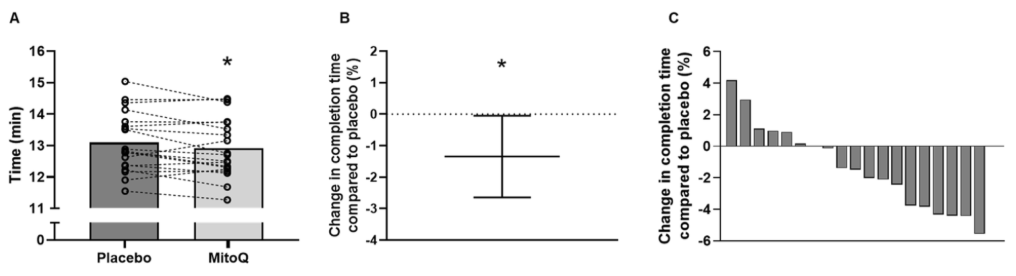
(A), percent change in time to complete time trial with MitoQ compared to placebo, data are presented as mean ± 95% CI (B), and individual percent change in time to complete the time trial with MitoQ compared to placebo (each grey bar represents one individual) (C). * p < 0.05 vs placebo for paired-samples t-test, n = 19
Image taken from Broome et al., 2022.
What are the implications for performance and training?
This study provides some of the strongest evidence currently available that MitoQ can improve a real-world performance outcome in trained athletes. Unlike many mechanistic studies that demonstrate changes in biomarkers without corresponding changes in performance, this trial showed a direct improvement in a meaningful athletic endpoint.
Importantly, the performance benefit occurred without reductions in effort perception, suggesting that the athletes were able to sustain higher power outputs before fatigue developed. This aligns with existing evidence that excessive ROS can impair muscular function during intense exercise and suggests that mitochondrial oxidative stress may contribute directly to performance limitation during high-power efforts.
The reduction in lipid peroxidation provides additional mechanistic insight. Rather than broadly suppressing all ROS signalling, MitoQ may selectively reduce the pathological component of exercise-induced oxidative stress while preserving the signalling responses required for adaptation. This distinction is especially important given concerns that conventional antioxidants may blunt training adaptations.
Taken together, these findings suggest that mitochondrial-targeted antioxidant supplementation may be most relevant during events characterised by sustained high-intensity effort, where oxidative stress becomes a meaningful contributor to fatigue. The results also support the broader concept that optimising mitochondrial redox balance can improve performance even in already-trained individuals whose aerobic systems are highly developed. Unlike studies in sedentary or clinical populations, the participants here were already relatively fit, making the observed improvement particularly noteworthy.
What should practitioners know about dosing and use?
Participants received 20 mg of MitoQ daily for 28 days before performance testing. The intervention was well tolerated, with no adverse effects reported. Improvements were observed in cycling performance, power output, and oxidative stress markers without changes in perceived effort or substrate utilisation during exercise. These findings suggest that MitoQ may be particularly useful in supporting performance during high-intensity endurance efforts rather than by altering aerobic capacity itself.
Read the full paper: Mitochondria-targeted antioxidant supplementation improves 8 km time trial performance in middle-aged trained male cyclists (DOI: 10.1186/s12970-021-00454-0).