Women’s cardiovascular health research: late-onset menopause, mitochondrial oxidative stress, and vascular ageing
Reviewed by Dr. Siobhan Mitchell (PhD), Neuroscience.
Cardiovascular disease risk rises substantially after menopause, but not all women experience the same trajectory. Epidemiological studies have consistently shown that women who reach menopause at a later age (55 years or older) have a lower risk of cardiovascular disease than women who experience menopause between 45 and 54 years. The biological mechanisms underlying this protection, however, have remained poorly understood.
This study investigated whether vascular endothelial function is better preserved in women with late-onset menopause and explored the role of mitochondrial oxidative stress and circulating lipid metabolites as potential mechanisms linking age at menopause with cardiovascular risk.
Research Summary
Evidence type: Cross-sectional human physiology study with mechanistic intervention and translational cell culture analyses
Claim strength: Mechanistic and functional evidence supported by human intervention
Population: 71 healthy postmenopausal women and 21 premenopausal women
Intervention: Acute supratherapeutic dose of mitoquinol (MitoQ; 160 mg) in a subset of postmenopausal women
Primary outcomes: Endothelial function (brachial artery flow-mediated dilation), mitochondrial oxidative stress signalling, serum metabolomics
Observed outcome: Late-onset menopause was associated with significantly higher endothelial function and lower mitochondrial oxidative stress-related suppression of vascular function
Causality: Supported for acute mitochondrial ROS modulation of endothelial function; long-term cardiovascular outcomes not assessed
Safety/tolerability: No safety concerns reported
Primary source: Circulation Research
What you'll learn
Why women who experience menopause later may have lower cardiovascular disease risk
How mitochondrial oxidative stress contributes to endothelial dysfunction after menopause
The role of circulating lipid metabolites in regulating vascular mitochondrial biology
What acute mitoquinol administration reveals about reversible mechanisms of vascular ageing
Why vascular endothelial function was targeted
Endothelial dysfunction is one of the earliest measurable changes preceding overt cardiovascular disease and is an independent predictor of future cardiovascular events. Previous work has shown that menopause accelerates endothelial dysfunction, partly through increased oxidative stress and reduced nitric oxide bioavailability. However, whether a later age at menopause protects against these changes had not been directly investigated.
Mitochondrial reactive oxygen species (mitoROS) are increasingly recognised as important contributors to age-related vascular dysfunction. Excess mitochondrial oxidative stress can reduce nitric oxide bioavailability, impair vasodilation, and promote pro-inflammatory signalling within the vascular wall.
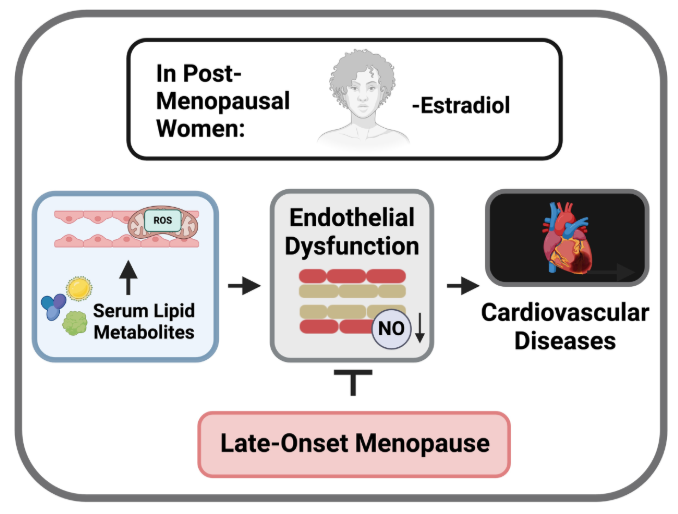
Image taken from Darvish et al., 2025.
What the study observed
Women who experienced menopause at age 55 years or older demonstrated markedly better endothelial function than age-matched women who experienced menopause between ages 45 and 54. Brachial artery flow-mediated dilation (FMD), a widely used marker of endothelial health, was more than 50% higher in the late-onset menopause group and was positively associated with age at menopause.
To investigate whether mitochondrial oxidative stress contributed to these differences, researchers administered an acute dose of mitoquinol (160 mg) to a subset of postmenopausal women. MitoQ improved endothelial function in both groups; however, the magnitude of improvement was substantially smaller in late-onset women, indicating that their endothelial function was already experiencing less tonic suppression from mitochondrial oxidative stress.
The investigators then exposed cultured human aortic endothelial cells to serum obtained from study participants. Serum from women with normal-onset menopause induced significantly greater mitochondrial ROS activity than serum from both premenopausal women and women with late-onset menopause. These findings suggest that circulating factors present after menopause contribute directly to mitochondrial oxidative stress within endothelial cells.
How do lipid metabolites influence mitochondrial oxidative stress?
A major strength of this study was the integration of serum metabolomics to identify potential molecular drivers of vascular mitochondrial dysfunction.
Researchers identified distinct lipidomic profiles between late- and normal-onset postmenopausal women. The most striking differences involved triglyceride-derived lipid metabolites, several of which were significantly lower in women with late-onset menopause. One metabolite in particular, TG(16:0), showed the strongest relationship with endothelial mitochondrial ROS production.
When concentrations of TG(16:0) in serum from premenopausal and late-onset women were experimentally increased to match those observed in normal-onset women, the differences in mitochondrial ROS activity disappeared. This finding provides direct mechanistic evidence that differences in circulating lipid metabolites contribute to differences in endothelial mitochondrial oxidative stress after menopause.
What are the implications for women’s cardiovascular health?
This study provides some of the strongest mechanistic evidence to date that age at menopause influences cardiovascular risk through effects on vascular biology rather than merely reflecting differences in chronological ageing.
The finding that endothelial function remained substantially higher in late-onset menopause despite similar age, blood pressure, cholesterol, and glucose levels suggests that traditional cardiovascular risk factors do not fully explain the protective effect associated with a later menopause transition. Instead, mitochondrial oxidative stress appears to be a key mediator.
Importantly, endothelial function in late-onset women remained significantly higher even after accounting statistically for years since menopause. This suggests that the timing of menopause itself may imprint long-term effects on vascular health that persist well beyond the immediate menopausal transition.
Taken together, these findings support the concept that mitochondrial oxidative stress is not merely a marker of vascular ageing but an active contributor to endothelial dysfunction in postmenopausal women. The results also identify circulating lipid metabolites as a previously underappreciated mechanism linking reproductive ageing to cardiovascular health. From a clinical perspective, this raises the possibility that mitochondrial-targeted interventions, particularly those that improve endothelial redox balance, could help reduce cardiovascular vulnerability in women who experience menopause earlier or who demonstrate evidence of accelerated vascular ageing.
What should practitioners know?
The acute MitoQ intervention demonstrated that a meaningful component of endothelial dysfunction in postmenopausal women remains reversible, even decades after menopause. Women with normal-onset menopause showed the greatest improvement following mitochondrial-targeted antioxidant administration, suggesting they may experience greater mitochondrial oxidative stress burden than women with later menopause onset.
These findings support a mechanistic role for mitochondrial oxidative stress in postmenopausal vascular ageing and provide a rationale for future longer-term intervention studies focused on cardiovascular prevention in women.
Read the full paper: Preservation of Vascular Endothelial Function in Late-Onset Postmenopausal Women (DOI: 10.1161/CIRCRESAHA.124.325639).