Mitoquinol's role in vascular aging and endothelial function
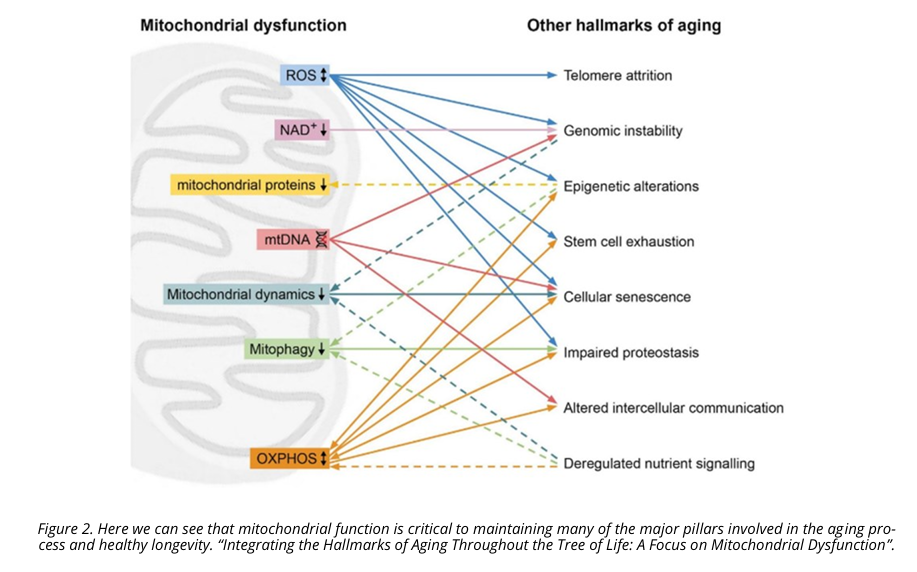
Mitochondrial dysfunction is increasingly recognized as one of the twelve hallmarks of aging¹ and is thought to contribute to many of the physiological changes that occur over time. Beyond their role in cellular energy production, mitochondria regulate redox balance, cellular signaling, inflammation, and vascular function. As mitochondrial function declines with age, cells may become less efficient at maintaining these processes, reducing tissue resilience and contributing to functional decline.
What you'll learn
What Mitoquinol is
How Mitoquinol differs from CoQ10
Why mitochondrial targeting matters
How Mitoquinol has been studied in relation to healthy aging biology
Mitochondrial dysfunction and vascular aging
Mitochondrial dysfunction is increasingly recognized as one of the twelve hallmarks of aging¹ and is thought to contribute to many of the physiological changes that occur over time. Beyond their role in cellular energy production, mitochondria regulate redox balance, cellular signaling, inflammation, and vascular function. As mitochondrial function declines with age, cells may become less efficient at maintaining these processes, reducing tissue resilience and contributing to functional decline.
One of the major mechanisms linking mitochondrial dysfunction to aging is oxidative stress. During normal energy production, mitochondria generate reactive oxygen species (ROS) as a natural by-product of oxidative phosphorylation. While ROS serve important signaling functions at physiological levels, excessive mitochondrial ROS can damage proteins, lipids, and mitochondrial DNA², and over time this accumulation of oxidative damage may impair mitochondrial function and further increase oxidative stress, creating a cycle that has been implicated in age-related cellular dysfunction.
These effects are particularly relevant to the vascular system. Healthy blood vessels rely on properly functioning mitochondria to maintain endothelial function, regulate vascular tone, and support normal blood flow. As mitochondrial oxidative stress increases with age, endothelial function often declines — a relationship demonstrated directly in a randomized, placebo-controlled trial in healthy older adults with impaired endothelial function³, contributing to changes in arterial health that are commonly observed in older adults. Increasing evidence suggests that mitochondrial dysfunction may be an important driver of vascular aging, making it a growing area of interest for longevity and cardiovascular researchers.
This connection between mitochondria and vascular aging has led researchers to investigate interventions that can target mitochondrial oxidative stress directly. However, a longstanding challenge has been that many conventional antioxidants circulate throughout the body without efficiently reaching the mitochondria themselves. Mitoquinol was developed to address this problem by enabling antioxidant activity to accumulate within mitochondria, where oxidative stress is generated and where age-related mitochondrial dysfunction often originates — the founding mechanism first reported in the Journal of Biological Chemistry in 2001⁴.
What is Mitoquinol?
Mitoquinol is a mitochondria-targeted antioxidant developed from CoQ10, a naturally occurring compound involved in cellular energy production and antioxidant defence. While CoQ10 plays an important role within mitochondria, conventional CoQ10 supplements are not designed to accumulate efficiently within these organelles. Mitoquinol was developed to overcome this challenge by enabling greater mitochondrial uptake and concentration, as described in the original synthesis paper by Kelso and colleagues⁴.
By combining the antioxidant properties of ubiquinol with mitochondria-targeting technology, Mitoquinol was specifically engineered to accumulate inside mitochondria, where oxidative stress is generated and where age-related mitochondrial dysfunction is thought to originate.
Why traditional CoQ10 faces delivery challenges
CoQ10 is essential for mitochondrial energy production and antioxidant defence. However, despite its importance within mitochondria, conventional CoQ10 faces significant delivery limitations.
CoQ10 is a large, fat-soluble molecule that is absorbed inefficiently and typically requires dietary fat to improve bioavailability. Even after absorption, only a small proportion is thought to reach mitochondria because of their highly selective membranes — a limitation explained in detail in Murphy and Smith's review of mitochondria-targeted antioxidant strategies⁵.
This creates a fundamental challenge. CoQ10 is required inside mitochondria to support normal function, yet conventional CoQ10 supplements are not specifically designed to accumulate there. Ubiquinol, the reduced form of CoQ10, faces similar limitations because it remains dependent on passive distribution throughout the body.
For researchers interested in mitochondrial health, the question is therefore not simply how much CoQ10 reaches the bloodstream, but how much ultimately reaches the mitochondria themselves.
The history and development of Mitoquinol
In the late 1990s, Professors Mike Murphy and Robin Smith sought to address this delivery challenge. Working at the University of Otago in New Zealand, they investigated why conventional antioxidants often failed to reach the site where much of cellular oxidative stress originates: the mitochondria.
Their solution was to modify the CoQ10 molecule by shortening its carbon chain and attaching a lipophilic positive charge. This allowed the molecule to cross biological membranes more efficiently and be attracted to the strong negative membrane potential found within mitochondria — a strategy first validated in mice in a 2003 PNAS study on delivering bioactive molecules to mitochondria in vivo⁶. The resulting compound was originally known as MitoQ10 and is now referred to as MitoQ® Mitoquinol.
This innovation represented one of the first successful strategies for selectively targeting antioxidants to mitochondria, establishing an entirely new category of compounds known as mitochondria-targeted antioxidants, as detailed in the foundational 2001 paper describing the compound's synthesis and mechanism⁴.
How Mitoquinol reaches the mitochondria
Mitoquinol consists of three key structural components:
An antioxidant head group derived from CoQ10 that can neutralize reactive oxygen species.
A shortened carbon chain that improves movement across biological membranes.
A positively charged triphenylphosphonium (TPP+) group that drives mitochondrial accumulation.
The TPP+ group is central to Mitoquinol's targeting mechanism. Because the inner mitochondrial membrane carries a strong negative charge, Mitoquinol is actively drawn into mitochondria where it can accumulate at concentrations substantially higher than non-targeted antioxidants⁷, driven by the Nernst-equation relationship between membrane potential and cation uptake.
Once inside the mitochondria, Mitoquinol becomes anchored within the inner mitochondrial membrane. This positioning allows the antioxidant portion of the molecule to interact directly with reactive oxygen species generated during oxidative phosphorylation and help support mitochondrial redox balance.
Importantly, Mitoquinol can also be recycled within the electron transport chain⁴. After donating electrons and becoming oxidized to mitoquinone, it can be converted back into its active mitoquinol form, allowing a single molecule to participate repeatedly in antioxidant activity.
Why mitochondrial targeting matters
Because mitochondrial oxidative stress has been implicated in vascular aging, endothelial dysfunction, and broader age-related declines in cellular function, researchers have increasingly focused on strategies that target oxidative stress at its source.
Mitoquinol's ability to accumulate directly within mitochondria distinguishes it from conventional antioxidants that remain broadly distributed throughout the body. This targeted delivery has made Mitoquinol one of the most extensively studied mitochondria-targeted antioxidants, with research spanning vascular aging, endothelial function, hypertension, peripheral artery disease, exercise physiology, and healthy aging populations — see the full list of active and completed Mitoquinol clinical trials tracked by MCRP.
What are mitochondria-targeted antioxidants?
Mitochondria are the main organelles responsible for producing ATP and reactive oxygen species (ROS) in our cells, and they're particularly susceptible to oxidative damage as a result. This irreversible oxidative damage within mitochondria has been implicated in a wide range of human diseases, which is where mitochondria-targeted antioxidants (MTAs) come in. Rather than circulating generally throughout the body like conventional antioxidants, MTAs are designed to be conjugated to a carrier — such as a lipophilic cation, liposome, or peptide — that actively transports their active antioxidant ingredient into the mitochondria themselves, allowing them to accumulate at high concentrations directly at the site of oxidative stress.
The most well-studied delivery system uses a lipophilic cation called triphenylphosphonium, or TPP+. TPP+ is the chemical backbone shared by several well-known MTAs, including MitoQ. Because TPP+ carries a positive charge and is highly fat-soluble, it's able to pass through both the cell membrane and the mitochondrial membrane, and is then drawn deep into the mitochondria by the strong negative charge that naturally exists across the inner mitochondrial membrane⁸. In practical terms, this is the mechanism that lets an antioxidant like Mitoquinol travel further into the cell than standard ubiquinol or CoQ10 — the antioxidant "cargo" is essentially the same, but the TPP+ tag acts as a delivery address specifically for the mitochondria.
The difference in delivery has a significant impact. While conventional, nontargeted antioxidants are poorly delivered to mitochondria even after being absorbed into the bloodstream, MTAs can accumulate at substantially higher concentrations within mitochondria⁹ than in surrounding tissue, allowing them to protect key tissues including the brain, liver, kidney, muscle, and heart, from oxidative damage.
Among mitochondria-targeted antioxidants, MitoQ and SkQ1 have been the most extensively studied, having been tested across various animal models as well as several human clinical trials. Research into this class of compounds has focused heavily on conditions closely tied to oxidative damage and ROS accumulation in mitochondria, including brain and neurological diseases, cardiovascular diseases, and cancer, with the overarching finding across this body of work being that mitochondrial redox balance is itself a legitimate, modifiable target for disease treatment and prevention.
What has clinical research investigated?
As a mitochondria-targeted antioxidant, Mitoquinol has been studied across a growing body of human clinical research, with vascular aging emerging as one of the most consistently investigated areas. Because excess mitochondrial reactive oxygen species is understood to be a key driver of age-related vascular dysfunction, researchers have specifically looked at whether reducing oxidative stress at the mitochondrial level can translate into measurable improvements in artery health.
A foundational trial in this space is Rossman and colleagues' 2018 study in Hypertension³, which examined 20 healthy older adults aged 60 to 79 with impaired endothelial function. Participants completed six weeks of Mitoquinol supplementation in a randomised, placebo-controlled crossover design. The results showed a marked improvement in the arteries' ability to dilate, alongside benefits to aortic health and lipid metabolism. This trial was significant because it was among the first to translate earlier preclinical, animal-based findings into human evidence, showing that a mitochondria-targeted antioxidant could meaningfully support vascular function simply by lowering oxidative stress at its cellular source. A follow-up mechanistic analysis¹⁰ using plasma from this same trial later showed the improvement was linked to reduced circulating oxidized LDL and lower endothelial cell oxidative stress.
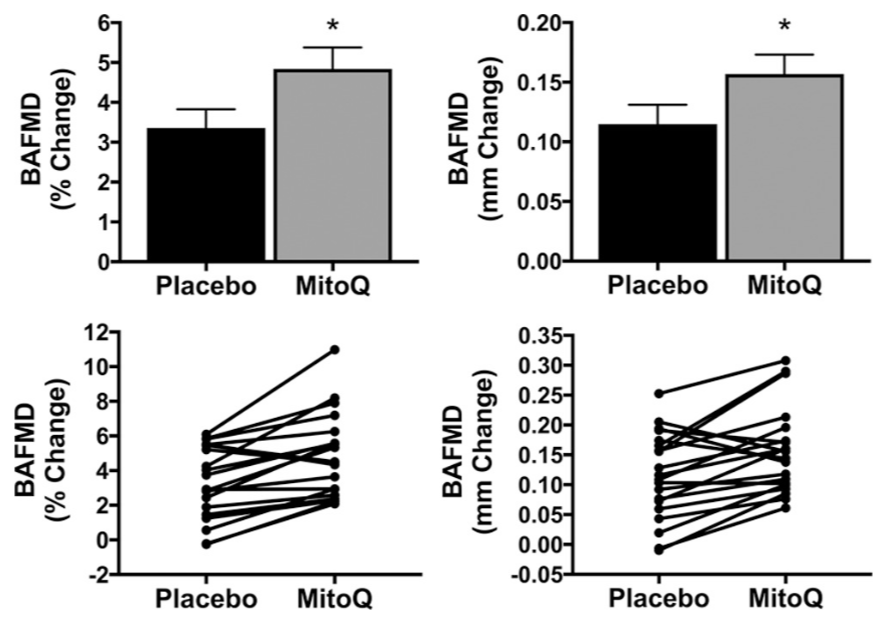
Image taken from Rossman et al., 2018.
Figure 2. Brachial artery flow–mediated dilation (BAFMD) expressed as percent (left) and absolute (right) change after 6 weeks of placebo or MitoQ supplementation. Values are presented as mean±SEM, with individual responses below. *P<0.05 vs placebo.
Building on this, more recent research has extended into specific cardiovascular conditions where vascular aging and oxidative stress play a central role. A trial in peripheral artery disease (PAD)¹¹ examined whether a single 80mg dose of Mitoquinol could improve claudication onset, maximal walking time, and leg artery dilation, offering insight into how mitochondrial dysfunction may contribute to the mobility impairment seen in PAD.
Separately, a randomised controlled trial in hypertensive adults¹² found that Mitoquinol reduced left ventricular mass and improved cardiac structural measures and lowered markers of oxidative stress and inflammation — with the strongest effects observed when supplementation was combined with exercise training.
Together, these studies point to a broader pattern in the research: mitochondrial-targeted antioxidants like Mitoquinol appear most effective in populations where oxidative stress and vascular dysfunction are already elevated, and their benefits may be amplified when paired with lifestyle factors such as regular physical activity - reinforcing the idea that supporting mitochondrial health and staying active may work hand in hand for long-term cardiovascular resilience. This is also consistent with a 2024 systematic review and meta-analysis¹³, which found MitoQ reliably reduces exercise-induced oxidative damage and may specifically benefit exercise tolerance in people with PAD, even though it does not appear to enhance aerobic performance in healthy populations.
Future directions in healthy aging research
While early trials like Rossman's 2018 study offered the first proof-of-concept that Mitoquinol could improve vascular function in humans, the current wave of research is moving toward larger, more targeted populations and longer-term outcomes. Several active trials registered with ClinicalTrials.gov are now investigating Mitoquinol specifically within the context of aging: the Mito-Frail Trial at UConn Health¹⁴ is examining MitoQ's effects on vascular function, oxidative stress, mobility, and cognitive performance in frail and non-frail older adults, while a study at Colorado State University¹⁵ is evaluating daily MitoQ against placebo over three months to assess cerebrovascular, or brain artery, function in postmenopausal women.
Vascular aging in the context of specific disease states is also drawing continued attention — researchers at the University of Nebraska are running a trial¹⁶ looking at whether MitoQ supplementation changes walking ability, daily activity, quality of life, and calf muscle-related measures in people with peripheral artery disease and intermittent claudication, extending the earlier PAD findings into longer-term, real-world functional outcomes. Beyond vascular aging specifically, trials are also underway examining MitoQ combined with ischemic conditioning for vascular health after stroke¹⁷, and its role in microvascular function tied to mitochondrial oxidative stress in healthy adults.
Together, these studies signal a shift from small proof-of-concept trials toward more clinically applied questions: not just whether Mitoquinol can reduce oxidative stress, but whether that translates into meaningful, measurable improvements in mobility, independence, and cardiovascular resilience as we age.
FAQs
What is Mitoquinol?
Mitoquinol is a targeted mitochondrial antioxidant that has been evaluated in multiple randomised, placebo-controlled human clinical trials³, most commonly at daily doses of 10–20mg, and used in aging and disease research to combat oxidative stress and support mitochondrial health. It's a modified form of ubiquinol (the active form of CoQ10) that's been chemically altered to concentrate specifically inside mitochondria, the energy-producing structures within our cells, rather than circulating more generally throughout the body.
How does Mitoquinol differ from CoQ10?
Both compounds share the same antioxidant core, but their behaviour in the body differs significantly. Standard CoQ10 (and its active form, ubiquinol) is absorbed and distributed throughout the body, with only a small fraction reaching mitochondria. Mitoquinol is engineered with an added chemical component (a triphenylphosphonium, or TPP+, group) that acts like a molecular delivery tag, allowing it to cross both the cell membrane and the mitochondrial membrane and accumulate at much higher concentrations inside mitochondria specifically⁴. This targeted delivery is the central distinction driving the clinical interest in Mitoquinol as a distinct compound rather than simply "more CoQ10."
What is a mitochondria-targeted antioxidant?
A mitochondria-targeted antioxidant is a compound designed to concentrate specifically within mitochondria, rather than being distributed evenly throughout the cell or bloodstream. Because mitochondria are a primary site of reactive oxygen species (ROS) production, a mitochondria-targeted antioxidant is positioned to intercept and neutralise oxidative damage closer to its source, rather than relying on diffuse, whole-body antioxidant activity.
Why target antioxidants to mitochondria?
Mitochondria are both the main energy producers in our cells and one of the main sources of oxidative stress, since reactive oxygen species are a natural byproduct of the energy-production process. These mechanisms underpin the use of mitochondria-targeted antioxidants in aging and longevity research models, with findings supporting the role of mitochondrial oxidative stress in vascular aging and endothelial dysfunction specifically³. Conventional, non-targeted antioxidants taken orally are largely diluted before they ever reach mitochondria in meaningful concentrations, since only a small fraction of what's absorbed makes it past the mitochondrial membrane.
By comparison, compounds designed to actively accumulate within mitochondria — MitoQ has demonstrated good tolerability and consistent biological effects aligned with mitochondrial redox modulation across studies¹³, and importantly, does not blunt physiological exercise adaptations, making it valuable for studying redox signalling rather than producing indiscriminate antioxidant effects — offer researchers a more precise tool for studying and potentially addressing oxidative stress right where a substantial share of it originates.
References
López-Otín C, Blasco MA, Partridge L, Serrano M, Kroemer G. Hallmarks of aging: an expanding universe. Cell. 2023;186(2):243–278.
Mitochondria in oxidative stress, inflammation and aging: from mechanisms to therapeutic advances. Signal Transduct Target Ther. 2025.
Rossman MJ, Santos-Parker JR, Steward CAC, et al. Chronic supplementation with a mitochondrial antioxidant (MitoQ) improves vascular function in healthy older adults. Hypertension. 2018;71(6):1056–1063.
Kelso GF, Porteous CM, Coulter CV, et al. Selective targeting of a redox-active ubiquinone to mitochondria within cells: antioxidant and antiapoptotic properties. J Biol Chem. 2001;276(7):4588–4596.
Smith RA, Murphy MP. Animal and human studies with the mitochondria-targeted antioxidant MitoQ. Ann N Y Acad Sci. 2010;1201:96–103.
Smith RA, Porteous CM, Gane AM, Murphy MP. Delivery of bioactive molecules to mitochondria in vivo. PNAS. 2003;100(9):5407–5412.
Asin-Cayuela J, Manas AR, James AM, Smith RA, Murphy MP. Fine-tuning the hydrophobicity of a mitochondria-targeted antioxidant. FEBS Lett. 2004;571(1–3):9–16.
Understanding and preventing mitochondrial oxidative damage. PMC review.
Graham D, Huynh NN, Hamilton CA, et al. Mitochondria-targeted antioxidant MitoQ10 improves endothelial function and attenuates cerebral vascular remodeling in hypertension. Hypertension. 2009.
Craighead DH, et al. Chronic mitochondria antioxidant treatment in older adults alters the circulating milieu to improve endothelial cell function and mitochondrial oxidative stress. Am J Physiol. 2023.
Park SY, Pekas EJ, Headid RJ, et al. Acute mitochondrial antioxidant intake improves endothelial function, antioxidant enzyme activity, and exercise tolerance in patients with peripheral artery disease. Am J Physiol Heart Circ Physiol. 2020;319(2):H456–H467.
Sarir H, et al. Moderate endurance training and MitoQ improve cardiovascular function, oxidative stress, and inflammation in hypertensive individuals: the role of miR-21 and miR-222. Cell J. 2022.
Effects of Mitoquinone (MitoQ) supplementation on aerobic exercise performance and oxidative damage: a systematic review and meta-analysis. Sports Med Open. 2024;10:79.
The Mito-Frail Trial: effects of MitoQ on vasodilation, mobility and cognitive performance in frail older adults (NCT06027554).
Oral antioxidant therapy targeted to the mitochondria for improving brain artery health in postmenopausal women (NCT07406243), Colorado State University.
MitoQ treatment of claudication: myofiber and micro-vessel pathology (NCT06409949), University of Nebraska.
MitoQ and ischemic conditioning to assess vascular health outcomes (MITO Study, NCT06930638), Medical College of Wisconsin.